
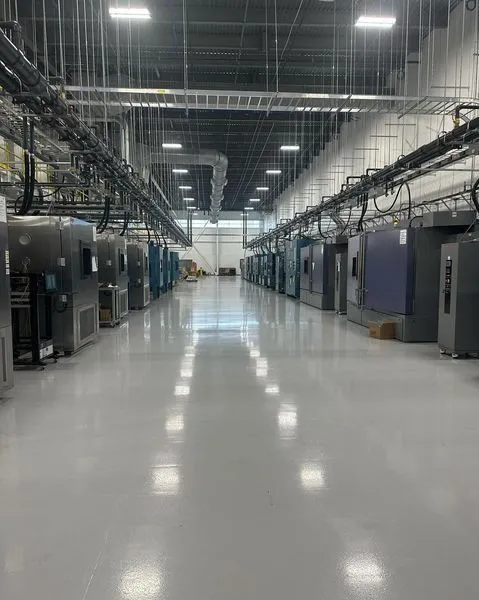
Mechanical rooms contain more floor interruptions than most commercial spaces. Pumps, boilers, air-handling units, generators, piping supports, housekeeping pads, drains, and concrete curbs break up what would otherwise be a continuous slab. These details can create maintenance challenges because water, oil, dirt, and cleaning residue often collect around their edges. Flooring projects should therefore consider how the resinous system meets raised equipment bases and curbs rather than concentrating only on the large open sections between them.
Equipment Pads Create Perimeter Stress
Housekeeping pads are commonly used to elevate machinery above the surrounding floor. They can help organize equipment and keep some components away from minor surface water, but they also create long perimeter edges.
These edges may be exposed to vibration, maintenance tools, oil drips, and repeated cleaning. If the concrete around the pad is cracked or poorly repaired, applying a new finish without addressing the substrate can leave a vulnerable transition.
Managers should inspect both the horizontal floor and the vertical face of the pad before resurfacing begins.
Vertical Surfaces Need Planning Too
A flooring specification may extend beyond the flat slab. Depending on the room, resinous materials can be detailed onto curbs, pads, or other vertical surfaces to create a more continuous finish.
Facilities researching Mechanical Room Flooring In Usa should discuss where these transitions need protection and how high the resin system should extend. The appropriate detail depends on exposure, equipment layout, maintenance practices, and the construction of the pad itself.
Treating vertical edges early is easier than trying to add protection after equipment has already been returned.
Vibration Can Affect Weak Transitions
Mechanical equipment can transmit vibration through its base and into the surrounding concrete. Pumps, generators, and HVAC equipment may create repeated movement over long operating periods.
A weak crack or old patch beside an equipment pad can therefore become more noticeable over time. Flexible resin layers or elastomeric components may be considered in suitable mechanical-room systems where vibration and minor substrate movement are concerns.
The flooring approach should be based on actual equipment and slab conditions rather than assuming every mechanical room needs the same system.
Water Often Collects Along Curbs
Condensation, small leaks, maintenance water, or cleaning can travel toward the base of raised pads and curbs. If the surrounding floor contains low spots, liquid may remain along those edges.
A resinous coating can create a continuous non-porous surface, but it cannot correct major drainage or slope problems by itself. Managers should observe how water behaves before installation and identify locations that remain wet longer than the rest of the room.
Concrete repairs or drainage adjustments may be needed before the final system is applied.
Preparation Around Pads Takes More Work
Large planetary grinders can prepare open concrete efficiently, but equipment pads, wall edges, and tight utility spaces require more detailed preparation.
An Epoxy Flooring For Mechanical Rooms project should include a clear plan for removing old coatings, contaminants, weak concrete, and failed sealants around these difficult areas. Mechanical preparation creates the surface profile needed for resin adhesion, while cracks and spalled sections should be repaired before coating.
The small details around equipment can determine whether the overall floor feels complete or patchy.
Texture Should Not Trap Maintenance Residue
Slip resistance can be useful in wet utility spaces, especially near pumps and drains. However, excessively aggressive texture around narrow equipment clearances may make cleaning difficult.
Oil, dust, and maintenance residue can collect where brushes or scrubbers have limited access. The surface profile should therefore balance traction with cleanability.
Open walkways may tolerate one texture level while tight equipment perimeters may benefit from a finish that remains easier to wipe or scrub.
Curbs Should Remain Inspectable
A newly finished room should still allow maintenance teams to identify leaks, cracks, or damaged edges. Equipment-pad perimeters should not become hidden beneath clutter or stored materials.
Routine inspections can focus on pad corners, anchor points, drain edges, joints, and areas with a history of leaks. Small chips or cracks are easier to address before vibration or moisture enlarges them.
Keeping these transitions visible also makes housekeeping more effective.
Conclusion
Mechanical room flooring performance depends heavily on details around housekeeping pads, curbs, equipment bases, and vertical transitions. These areas combine vibration, moisture, maintenance activity, restricted access, and difficult preparation within a small footprint.
A stronger flooring strategy treats equipment pads as part of the complete system rather than obstacles in the middle of the room. Careful concrete inspection, detailed mechanical preparation, suitable resin layers, balanced texture, and regular perimeter checks can create a more maintainable surface around the equipment that supports critical building operations.